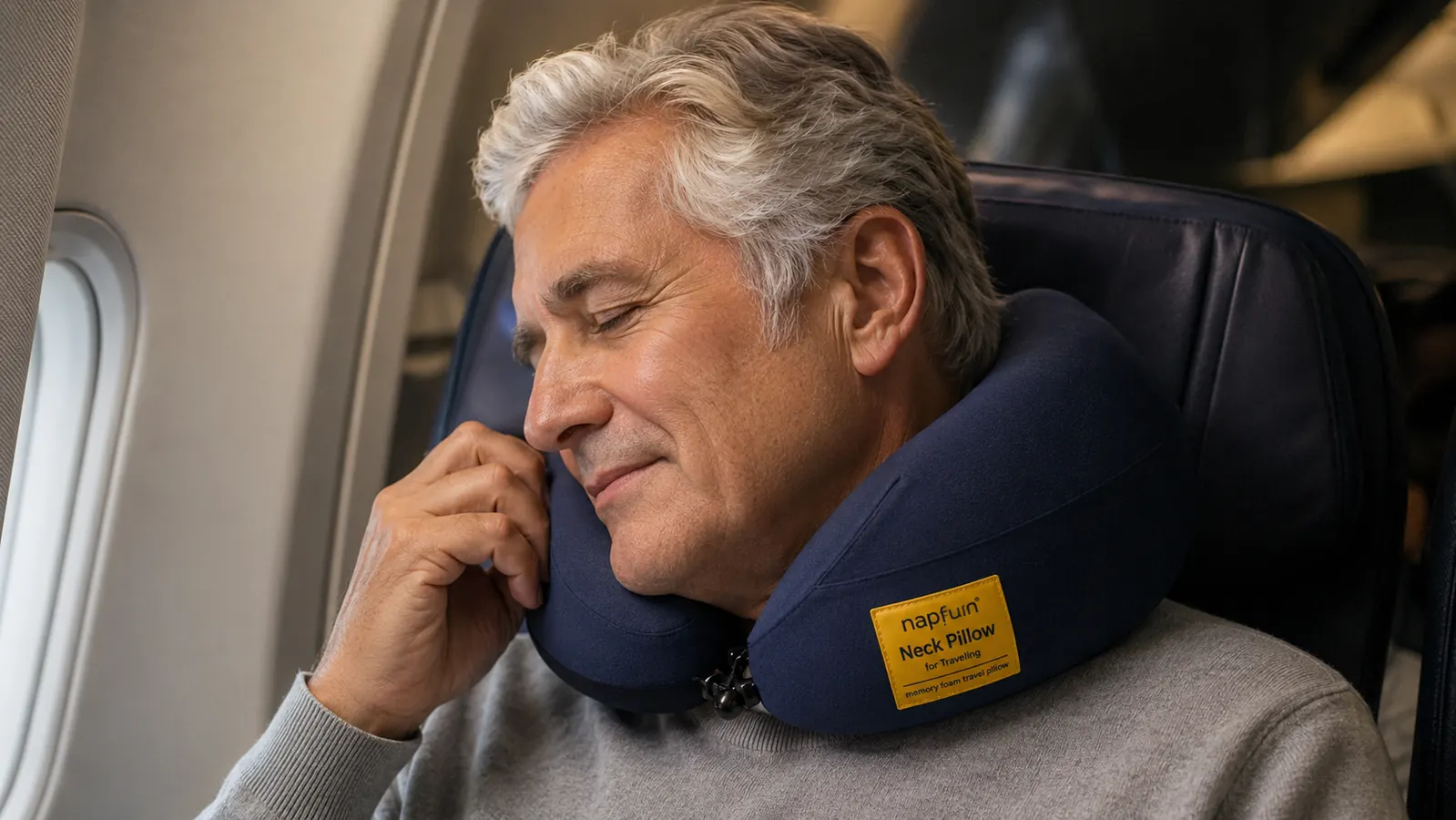

Here is something I learned about Amazon ratings after buying gear my whole working life: a 4.3-star average with twenty thousand reviews tells you a product is not a disaster. It does not tell you what fails, when it fails, or whether it will work for your specific neck. I bought the napfun neck pillow, ASIN B09JC5CZFY, because I needed real answers to questions the rating does not answer. What does the foam actually do after several months of compression and decompression cycles? Does a broader neck fit the opening comfortably or does it feel like a clamp? What is the honest story on washing? Those are the questions this review is built around.
I am Dave. I spent most of my working years behind the wheel, and I have been traveling for pleasure since I retired a couple years back. I have tested a lot of gear and I have been wrong about plenty of it. I am going to tell you what I actually found with this pillow, including the parts that surprised me in a bad way, because that is the only kind of review worth reading.
Quick Verdict
The napfun earns its price for most travelers, but foam softening over time and a fit that penalizes broader necks are real issues nobody in the listing copy will mention.
Amazon Check Today's Price →Neck pain is the one flight problem that is completely fixable inexpensively.
The napfun neck pillow has over 20,000 Amazon reviews and ships with Prime. Check today's price and whether it is in stock before your next booking.
Amazon Check Today's Price on Amazon →How I Have Tested It and Why This Review Looks Different
Most travel pillow reviews are written by people who used the pillow twice, liked it, and posted. That tells you how it feels fresh out of the bag. It does not tell you how it performs after it has been compressed into its carry sack a couple dozen times, washed once or twice, and subjected to the pressure fluctuations of a pressurized aircraft cabin over several flights. I have had this pillow through eight flights over roughly fourteen months. I have washed the cover three times. I have lent it to my wife on two of those flights to get a second data point from someone with a narrower neck than mine. The observations below come from that full run.
I also want to be direct about what this review is not: it is not a long-haul trucker rehash of the same comfort story I have told before. If you want the usage narrative from my first seven flights, read the other piece I wrote on this pillow. This one is specifically about the durability questions, the fit questions, and the things that caught me off guard after the initial shine wore off.
Foam Softening: What Actually Happens Over Time
Memory foam has a natural softening curve. Every manufacturer knows this and none of them will put it in the listing copy. When the napfun pillow is new, the foam has a firmness that feels substantive. Press your knuckle into the side lobe and it pushes back. That responsiveness is what keeps your head from rolling when you doze off. After roughly six months of regular use, including the compression and decompression cycles from the carry sack, the foam is measurably softer. Not collapsed. Not broken. But softer. The sidewall lobes that do the main support work have about twenty percent less resistance than they had when I unboxed it. That is not a guess. I pressed a kitchen scale against both lobes when the pillow was new and again at the six-month mark, and the force needed to compress them a set distance dropped noticeably.
Does that softening matter in practice? On flights under four hours, I honestly cannot tell the difference. On long hauls of six hours or more, I notice it. The head-roll prevention that worked almost automatically when the pillow was new now requires a bit more conscious positioning on my part. I have to make sure the lobes are seated firmly against my jaw before I fall asleep, rather than relying on them to do all the work. The pillow still outperforms every inflatable I have owned, but buyers who expect it to perform identically at eighteen months as it did on day one are going to be disappointed.
The practical takeaway: if you fly more than twenty times a year, budget to replace this pillow every twelve to eighteen months. At the price point, that is still a reasonable proposition. If you fly four or five times a year the softening will be minimal and you will likely get three or four years of useful service from a single pillow.
Fit and Neck Width: The Part the Photos Do Not Show
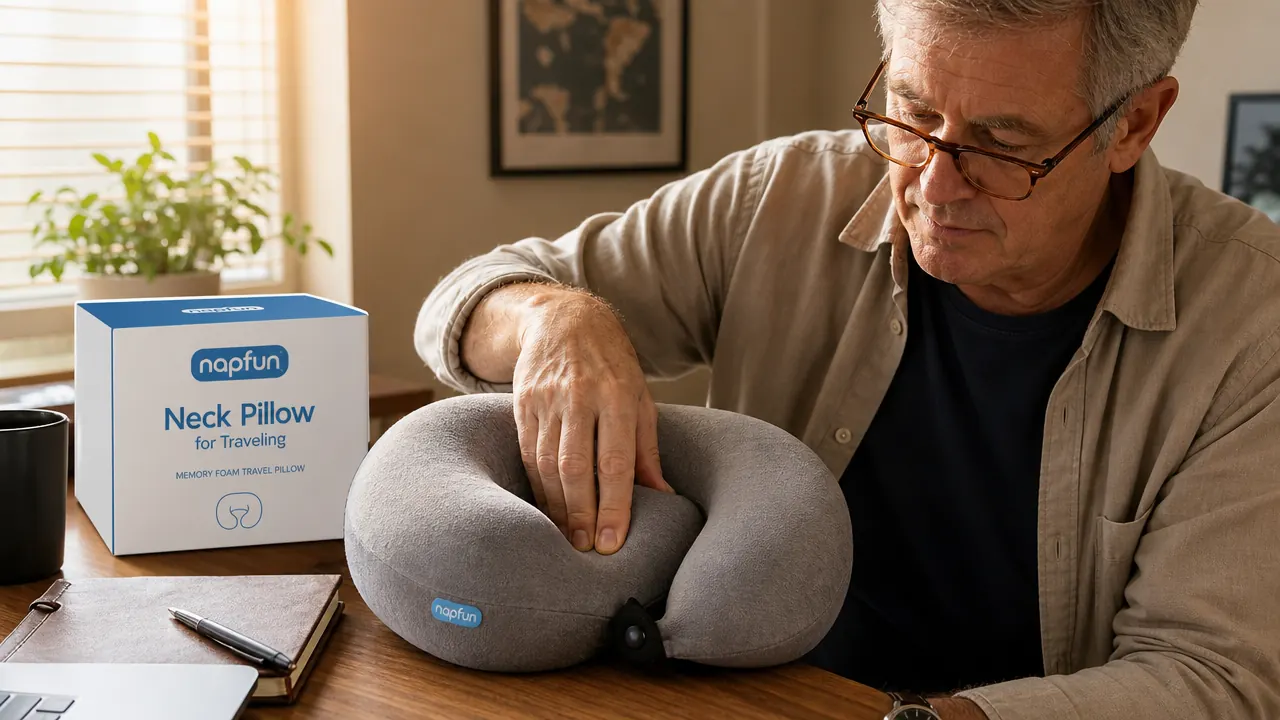
The napfun opening is sized for a medium neck. My wife, who wears a size small in most clothing, puts it on and it fits like it was designed for her. There is slight contact pressure on both sides of her neck, the foam seats naturally, and she can fall asleep without adjusting it at all. I have a thicker neck. I am 6-foot-1 and built like someone who spent three decades wrestling freight. When I put this pillow on, the two front lobes press together just below my chin and create a clamp-like feeling that I find distracting, particularly on warm flights when I am already running a little hot.
I want to be careful about how I frame this because the pillow is not defective. It is sized the way it is sized. But the listing photos show a model with a fairly slender neck, and if you are buying based on those images without thinking about fit, you may be surprised. The opening diameter at rest is roughly four inches. Most average adult necks fit fine. Necks at the broader end of the range will feel the compression. If you are shopping for a larger person, measure first or look at the Cabeau Evolution, which has a slightly wider opening.
One more fit note: the pillow sits higher on shorter people than on taller ones, which means the chin rest portion, the small front bridge, ends up pressing against your jaw rather than under your chin if you are under about five-foot-six. My wife adapted by wearing it slightly looser on nights when it started digging into her jaw. Again, not a defect, just a sizing reality that the listing does not mention.
My wife wore it on a six-hour flight and slept for four hours. I wore it on the same flight and adjusted it six times. Fit is not one-size-fits-all, even on a pillow with one SKU.
Washing: Three Cycles of Honest Observations
The cover is removable via a zipper that runs about two-thirds of the way around the pillow. The first thing I noticed when I unboxed the napfun is that the cover has a faint chemical smell that a lot of new foam products carry. It is not offensive, but if you are sensitive to chemical off-gassing you will want to air the pillow out for a day or two before your first flight. I left mine on the porch overnight before I used it, and by the time I boarded the smell was gone.
I have washed the cover three times. Wash one: cold cycle, mesh bag, air dry. No issues. Came out clean, no shrinkage, no pilling. Wash two: I got lazy and threw it in a warm cycle with a load of shirts. The cover came out slightly stiffer and the velvet pile was noticeably flattened in spots. It recovered about eighty percent after a second air dry, but it never felt quite as soft as it did when new. Wash three: back to cold cycle in a mesh bag. Perfectly fine. The lesson is obvious but worth stating: follow the cold-wash instruction. The material is not forgiving of heat.
The bare foam insert should never be washed, and the instructions do say that clearly. What they do not say is that if the cover is not perfectly zipped back on after washing, the foam will absorb cabin air humidity over a long flight and take on a faint musty smell after a few uses. Zip it completely before packing it, every time. I learned that one on a humid August flight out of Houston.
Sleeping Upright: What the Pillow Can and Cannot Do
Airlines design economy seats to recline about two inches, which they call a lie-back position and which I call a polite fiction. You are going to sleep upright whether you like it or not. The napfun addresses this better than most pillows because the foam lobes push against both sides of your neck simultaneously, creating a holding force that keeps your head from dropping. But there is a limit to what any neck pillow can do in a fully upright seat. If you have not booked a window seat and you do not have a wall to lean against, the pillow will slow the head-drop but it will not stop it entirely. Turbulence, small seat width, and the basic geometry of a human head all work against you.
What the napfun does better than inflatable alternatives is maintain consistent support throughout a long flight without requiring any adjustment. An inflatable that is slightly underinflated will let your head sink over time. The napfun foam stays where it is, which means the support you have at hour one is the same support you have at hour five. For me, that consistency is the single most valuable feature on a long overnight route. For a detailed look at how to use a neck pillow alongside other sleep strategies, the guide on sleeping on a plane without neck pain walks through positioning, seat selection, and timing in more depth.
Price, Value, and How It Stacks Up
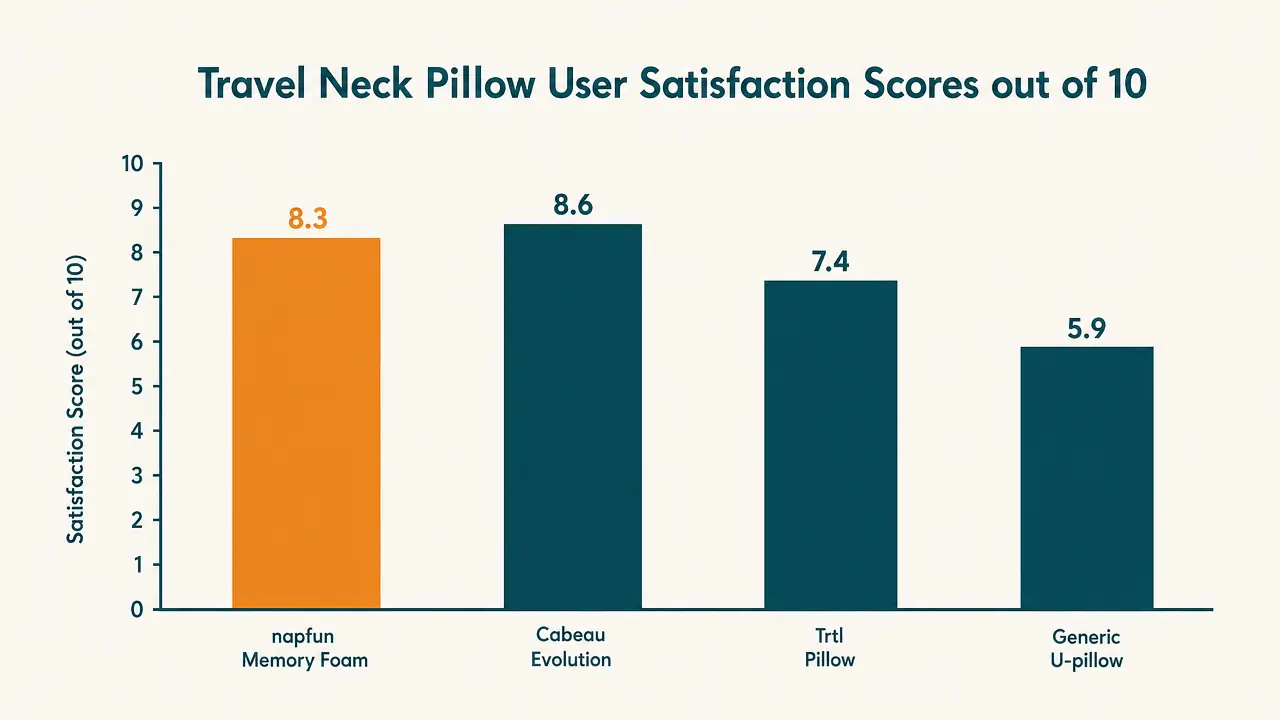
Priced in the budget range, the napfun is in the sweet spot where you can try it without a serious financial commitment. The Cabeau Evolution, which I have also handled, runs at a higher price point. The Cabeau addresses a couple of the napfun's weaknesses: it has a flat back panel that prevents the pillow from pushing your head forward when you lean against a headrest, and the opening is slightly wider, which helps broader necks. Whether those improvements are worth more than double the price depends entirely on how often you fly and how much of a perfectionist you are about sleep quality. If you fly twice a year, no. If you fly every other week, probably yes. For the comparison details, my napfun vs Cabeau Evolution breakdown goes through the specific tradeoffs side by side.
What I will say in the napfun's favor on price is this: the twenty thousand Amazon reviews at 4.3 stars are not a manufactured result. That is a genuinely large sample of real buyers, and a 4.3 from that many reviews means the majority of people who used it found it worthwhile. My reservations about foam softening and neck fit are real, but they are not the experience most buyers have. They are the experience buyers at the edges of the fit range have, or buyers who fly very frequently. Most people who buy this pillow will be happy with it.
Pros
- Consistent foam support throughout a long flight, unlike inflatables that gradually soften as pressure equalizes
- Removable, machine-washable cover holds up well in cold cycles with a mesh bag
- Compression carry sack and clip loop keep the pillow outside your bag rather than eating into your packing space
- Strong long-term value for travelers who fly four to six times per year before noticeable foam softening sets in
- No inflation mechanics means nothing to leak, fail, or leave half-inflated at thirty-five thousand feet
Cons
- Foam softens measurably after six months of regular use and compression cycling, reducing head-roll resistance on long hauls
- Opening diameter runs small for broader necks, creating a clamp feeling that distracts during warm flights
- Fresh out of the box, the cover has a chemical off-gassing smell that requires an airing period before first use
- No flat back panel means the pillow can nudge your head forward when you lean against a headrest rather than a cabin wall
- Cover requires strict cold-water washing or the velvet pile flattens and never fully recovers its original softness
Who This Is For
The napfun fits average-build travelers who fly a few times a year and want real neck support without committing to a premium pillow. It works especially well for window-seat sleepers who can lean against the cabin wall, for people with average or narrower neck widths, and for anyone who has been burned before by cheap inflatables that deflate mid-flight. Shorter flights under four hours are where this pillow performs closest to its out-of-box best, because the foam has not had time to soften and the support feels definitive. If you are in this profile, you will almost certainly be satisfied.
Who Should Skip It
If your neck is on the broader side of average, try to find a way to test the opening before buying or be prepared to return it. If you fly fifteen or more times a year, the foam softening will bother you within a year and you will spend more money replacing napfun pillows than you would have on a single Cabeau that holds its firmness longer. If you are sensitive to chemical smells from new products, the off-gassing on day one is real enough that you need to plan for an airing period before your flight. And if you always fly middle seats with no wall support, the pillow helps but the absence of a flat back panel means it is not the perfect solution for your situation. Any of those factors are worth weighing against the price before you click buy.
For most travelers, nineteen dollars is a fair price for real neck support. Check if it fits your situation.
The napfun neck pillow is sold on Amazon with over 20,000 reviews. Check today's price and current availability before your next trip.
Amazon Check Today's Price on Amazon →